Posts

SHIN YANAGISAWA – ANDREI MOLODKIN

SHIN YANAGISAWA – ANDREI MOLODKIN


June 9th – September 1st, 2012
| DE

Galerie Priska Pasquer is pleased to present the exhibition ‘Shin Yanagisawa – Andrei Molodkin’. This is the second exhibition at Galerie Priska Pasquer (before ‘Sherrie Levine – August Sander’) in which photography is paired with sculpture in order to create an open dialog between artworks from different contexts and genres.
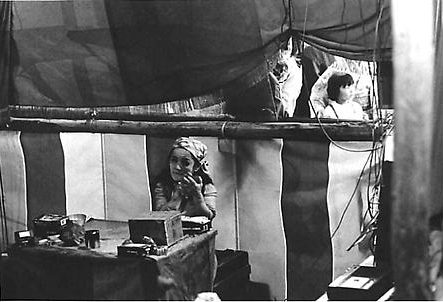
In this exhibition the Japanese photographer Shin Yanagisawa (1936 – 2008) is being exhibited outside Japan for the fist time. The exhibition presents two bodies of work: cityscapes and street scenes from series ‘Tracks of the City’ from the 1960s and early 1970s and from the series ‘Hard Winter’ nude photographs taken during the artists travels to Northern Japan.
Shin Yanagisawa’s work has been regarded as ‘unique and eccentric’ (Ryuichi Kaneko) and is being appreciated by photographer colleagues like Daido Moriyama or Yutaka Takanashi, with whom he participated in the group show ‘Fifteen Photographers Today’ at the National Museum of Modern Art, Tokyo in 1974.
Shin Yanagisawa’s city scenes are being characterized by their elaborate construction of the photographed space within the frame of the image. The depiction of the streets and rooms oscillate between complexity and reduction, whilst avoiding a simple perspective. His compositions are often constructed with diagonals to create the impression of shifting, layered spaces. Yanagisawa intensifies this impression through the deliberate use of light and shadow to set accents or to subdue other parts of the scene. Almost all of Yanagisawa’s street scenes embody people, but they are rarely shown in frontal view. The people seem to be in transit in places that often look inhospitable.
The series ‘Hard Winter’ consists of nude photographs. In the way Yanagisawa depicts his subject the images imply a position of the photographer for which the photographer Nobuyoshi Araki has coined the term ‘I-photography’. The photographer has given up his position as noninvolved observer, but even though not being directly visible in the image he becomes part of the act.

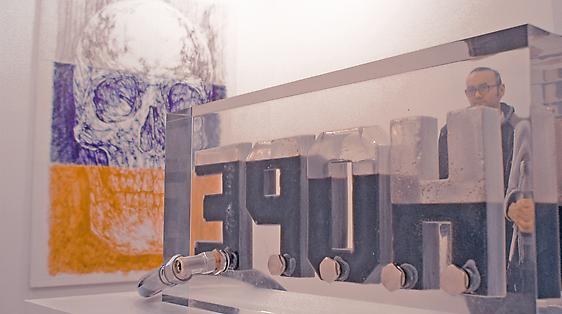
The photographs are being juxtaposed with the wall sculpture ‘Neon-Oil’ by the Russian artist Andrei Molodkin. The artist (*1966), who has a major exhibition at Museum Villa Stuck in Munich curated by Margarita Tupitsyn and Victor Tupitsyn (June 21 – Sept. 16, 2012), attained international recognition in recent years owing to his politically motivated crude oil sculptures and large-scale ballpoint pen drawings. In ‘Neon-Oil’ Molodkin adjoins a black tube saturated with crude oil and a white fluorescent tube. With the use of crude oil, the base material that powers all industrial societies, Molodkin’s work critically alludes to international politics and big capital, while the fluorescent tube evokes Dan Flavin’s light sculptures. Using the same material Dan Flavin exploits the fragility of fluorescent tubes to create ‘a sensation of volatility of cultural icons’ while for Andrei Molodkin they signify in Margarita Tupitsyn’s words the ‘means of social control.’

SHIN YANAGISAWA
1936 Born in Mukojima, Tokyo
1957 Graduates from the art department of Tokyo Junior College of Photography.
Leaves Kuwazawa Design Institute for free-lance work
1958 Yanagisawa’s first work published, in Rokkor magazine
1961 Three-man show with Yoshihiro Tatsuki and Setsu Kasanuki, Fuji Photo Salon, Tokyo
1967 Receives the New Photographers’ Award from the Japan Photography Critics Association
1974 Fifteen Photographers, Tokyo National Museum of Modern Art
1979 Tracks of the City, Olympus Gallery, Tokyo (solo exhibition)
1980 Hokuriku Traveller’s Journal. Minolta Photo Space, Tokyo (solo exhibition)
1994 Italy Photographs, Konica Plaza, Tokyo (solo exhibition)
2001 Return to Photography. Guardian Guarden Gallery G8 (solo exhibition)
2008 Dies in Tokyo

Publications
1978 Tracks of the City. Asahi Sonorama, Tokyo
1981 Hokuriku Traveller’s Journal. Shueisha, Tokyo
1990 Photographs 1964-1986. Shoshi Yamada, Tokyo
2009 Photographs. JCII Photo Salon, Tokyo

ANDREI MOLODKIN
1966 Born in Boiu, Russia
1976-1980 Attended the Special School of Arts-Plastiques, Boui
1981-1985 College of Arts, Krasnoe-on-Volga
1985-1987 Military Service
1987-1992 Faculty of Interior Architecture of the Stroganov Art Academy, Moscow

Lives and works in Paris and New York.
The artist has had his works featured in many individual and group exhibitions in Western and Eastern Europe and in the USA. Furthermore, his works have been covered in publications such as Art Forum, Art Press, Third Text, Kh/Zh, the New York Times, the Village Voice and the Independent.

Publications
2007 Cold War II, Ed. Margarita Tupitsyn, Victor Tupitsyn, Kashya Hildebrand
Gallery, Zurich
2009 Liquid Modernity. Ed. Margarita Tupitsyn, Victor Tupitsyn, Orel Art, London
2009 Holy Oil. Ed. Margarita Tupitsyn, Victor Tupitsyn, Tretyako Gallery, London

| EN

Galerie Priska Pasquer is pleased to present the exhibition ‘Shin Yanagisawa – Andrei Molodkin’. This is the second exhibition at Galerie Priska Pasquer (before ‘Sherrie Levine – August Sander’) in which photography is paired with sculpture in order to create an open dialog between artworks from different contexts and genres.
In this exhibition the Japanese photographer Shin Yanagisawa (1936 – 2008) is being exhibited outside Japan for the fist time. The exhibition presents two bodies of work: cityscapes and street scenes from series ‘Tracks of the City’ from the 1960s and early 1970s and from the series ‘Hard Winter’ nude photographs taken during the artists travels to Northern Japan.
Shin Yanagisawa’s work has been regarded as ‘unique and eccentric’ (Ryuichi Kaneko) and is being appreciated by photographer colleagues like Daido Moriyama or Yutaka Takanashi, with whom he participated in the group show ‘Fifteen Photographers Today’ at the National Museum of Modern Art, Tokyo in 1974.
Shin Yanagisawa’s city scenes are being characterized by their elaborate construction of the photographed space within the frame of the image. The depiction of the streets and rooms oscillate between complexity and reduction, whilst avoiding a simple perspective. His compositions are often constructed with diagonals to create the impression of shifting, layered spaces. Yanagisawa intensifies this impression through the deliberate use of light and shadow to set accents or to subdue other parts of the scene. Almost all of Yanagisawa’s street scenes embody people, but they are rarely shown in frontal view. The people seem to be in transit in places that often look inhospitable.
The series ‘Hard Winter’ consists of nude photographs. In the way Yanagisawa depicts his subject the images imply a position of the photographer for which the photographer Nobuyoshi Araki has coined the term ‘I-photography’. The photographer has given up his position as noninvolved observer, but even though not being directly visible in the image he becomes part of the act.

The photographs are being juxtaposed with the wall sculpture ‘Neon-Oil’ by the Russian artist Andrei Molodkin. The artist (*1966), who has a major exhibition at Museum Villa Stuck in Munich curated by Margarita Tupitsyn and Victor Tupitsyn (June 21 – Sept. 16, 2012), attained international recognition in recent years owing to his politically motivated crude oil sculptures and large-scale ballpoint pen drawings. In ‘Neon-Oil’ Molodkin adjoins a black tube saturated with crude oil and a white fluorescent tube. With the use of crude oil, the base material that powers all industrial societies, Molodkin’s work critically alludes to international politics and big capital, while the fluorescent tube evokes Dan Flavin’s light sculptures. Using the same material Dan Flavin exploits the fragility of fluorescent tubes to create ‘a sensation of volatility of cultural icons’ while for Andrei Molodkin they signify in Margarita Tupitsyn’s words the ‘means of social control.’

SHIN YANAGISAWA
1936 Born in Mukojima, Tokyo
1957 Graduates from the art department of Tokyo Junior College of Photography.
Leaves Kuwazawa Design Institute for free-lance work
1958 Yanagisawa’s first work published, in Rokkor magazine
1961 Three-man show with Yoshihiro Tatsuki and Setsu Kasanuki, Fuji Photo Salon, Tokyo
1967 Receives the New Photographers’ Award from the Japan Photography Critics Association
1974 Fifteen Photographers, Tokyo National Museum of Modern Art
1979 Tracks of the City, Olympus Gallery, Tokyo (solo exhibition)
1980 Hokuriku Traveller’s Journal. Minolta Photo Space, Tokyo (solo exhibition)
1994 Italy Photographs, Konica Plaza, Tokyo (solo exhibition)
2001 Return to Photography. Guardian Guarden Gallery G8 (solo exhibition)
2008 Dies in Tokyo

Publications
1978 Tracks of the City. Asahi Sonorama, Tokyo
1981 Hokuriku Traveller’s Journal. Shueisha, Tokyo
1990 Photographs 1964-1986. Shoshi Yamada, Tokyo
2009 Photographs. JCII Photo Salon, Tokyo

ANDREI MOLODKIN
1966 Born in Boiu, Russia
1976-1980 Attended the Special School of Arts-Plastiques, Boui
1981-1985 College of Arts, Krasnoe-on-Volga
1985-1987 Military Service
1987-1992 Faculty of Interior Architecture of the Stroganov Art Academy, Moscow

Lives and works in Paris and New York.
The artist has had his works featured in many individual and group exhibitions in Western and Eastern Europe and in the USA. Furthermore, his works have been covered in publications such as Art Forum, Art Press, Third Text, Kh/Zh, the New York Times, the Village Voice and the Independent.

Publications
2007 Cold War II, Ed. Margarita Tupitsyn, Victor Tupitsyn, Kashya Hildebrand
Gallery, Zurich
2009 Liquid Modernity. Ed. Margarita Tupitsyn, Victor Tupitsyn, Orel Art, London
2009 Holy Oil. Ed. Margarita Tupitsyn, Victor Tupitsyn, Tretyako Gallery, London
ROSTA x MOLODKIN Russian Avant-Garde x Andrei Molodkin

ROSTA x MOLODKIN
Russian Avant-Garde x Andrei Molodkin

September 5th – October 27th, 2009

| DE

In this exhibition, political avant-garde art from the former Soviet Union rubs shoulders with the current political works of Russian artist Andrei Molodkin. The latter attained international recognition in recent years owing to his politically motivated crude oil sculptures and large-scale ballpoint pen drawings and is currently representing Russia at the Venice Biennale.
The exhibition will feature hand-painted Russian avant-garde posters – known as ‘Rosta windows’ – which were produced during a time of internal and external upheaval. The Rosta windows are the first Soviet propaganda posters published by the Russian telegraph agency ‘Rosta’ between September 1919 and February 1922 under the supervision of Vladimir Mayakovsky.
A new ballpoint pen work by Andrei Molodkin (born 1966) will also be on display.
The Rosta windows dealt with political, military and economic themes and were displayed in the shop windows of Moscow. Rather than printed posters in the conventional sense, they were hand-painted by some of the most prominent Russian avant-garde artists of the time.
Vladimir Mayakovsky was one of the first Russian artists to devote themselves to the revolution and one of the most committed to it. He saw the political and artistic revolution in the years following 1917 as being one inextricable unit. Mayakovsky described the Rosta windows as “a nation of 150 million being served by hand by a small group of painters”. He was responsible for creating roughly 9/10 of the texts. He was also instrumental in shaping the bold, stark-coloured, laconic yet dynamic forms used in the funny, but often grotesque and folksy drawings in a marriage of political potency and modern imagery.
In its latest exhibition, Galerie Priska Pasquer juxtaposes these outstanding political posters with a new ballpoint pen work by Russian artist Andrei Molodkin.
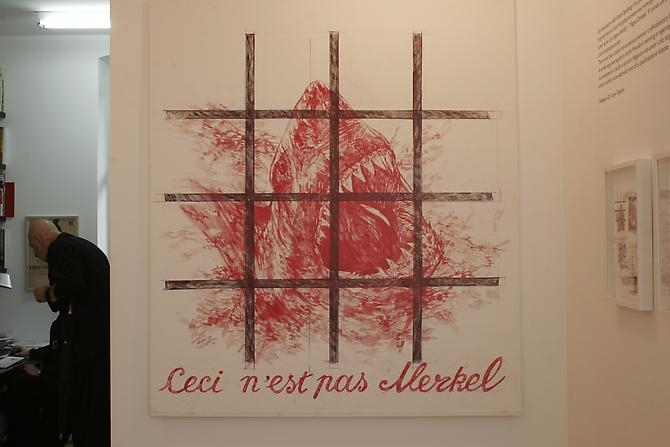
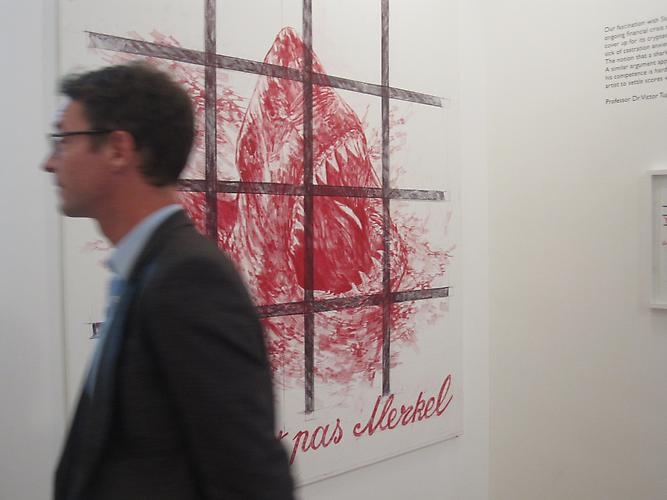
It was during his time as a soldier that Andrei Molodkin began his ballpoint pen drawings, which have a predominantly political focus. In this work – ‘Ceci n’est pas Merkel’ – Molodkin plays with an image of the ‘financial shark’ used by German left-of-centre party SPD for its election poster campaign in spring 2009, with a definite nod to a painting of Belgian surrealist René Magritte.
The exhibition also features vintage photography by Alexander Rodchenko, one of the protagonists of Russian Modernism.
Before Rodchenko adopted the medium of photography in the mid-1920s, he had already made a name for himself in Moscow as a versatile and innovative artist.
Rodchenko’s approach to photography was a radical departure from the art photography that held sway at the turn of the century. The aim was to revolutionise the perspective of photography, offering a “new perspective” that would change society and people – in a time of epoch-making changes in Russia and Europe alike.

QUOTATION
The last series of the ROSTA posters was issued at the time when the Constructivists defied easel painting and committed themselves to production art. Thus the ROSTA collective, with the poet and artist Vladimir Mayakovsky on board, contributed to the new phase of the Russian avant-garde that guarded art from succumbing to the level of mere commodity. Success-fully advanced by the post-war neo-avant-garde artists, this paradigm of socially conscious aesthetics has fallen — under the pressure of today’s narcissistic individualism — into the category of endangered species. Andrei Molodkin’s ballpoint drawings that pulsate with the muscle power of “the artist as producer,” resuscitate the productivist model of art making; this time he renders a dichotomous image of a bloody shark reminding us that this mode of production is simultaneously powerful and vulnerable.
Dr. Margarita Tupitsyn

QUOTATION
Our fascination with Steven Spielberg’s film Jaws (1975) hints at the possibility that at the time of the ongoing financial crisis the global economy has misrecognized itself for a shark or used this image as a cover up for its crypted identity – “Vagina Dentata.” If “animals are sick of surplus value,” men must be sick of castration anxiety.
The notion that a shark is an exceptional swimmer is self-explanatory because it lives in water. A similar argument applies to Andrei Molodkin’s swimming in negativity. For as long as he stays there, his competence is hardly in question. Negativity mon amour is the slogan of today, for it prompts the artist to settle scores with what none of us should accept or tolerate.

Professor Dr. Victor Tupitsyn

| EN

In this exhibition, political avant-garde art from the former Soviet Union rubs shoulders with the current political works of Russian artist Andrei Molodkin. The latter attained international recognition in recent years owing to his politically motivated crude oil sculptures and large-scale ballpoint pen drawings and is currently representing Russia at the Venice Biennale.
The exhibition will feature hand-painted Russian avant-garde posters – known as ‘Rosta windows’ – which were produced during a time of internal and external upheaval. The Rosta windows are the first Soviet propaganda posters published by the Russian telegraph agency ‘Rosta’ between September 1919 and February 1922 under the supervision of Vladimir Mayakovsky.
A new ballpoint pen work by Andrei Molodkin (born 1966) will also be on display.
The Rosta windows dealt with political, military and economic themes and were displayed in the shop windows of Moscow. Rather than printed posters in the conventional sense, they were hand-painted by some of the most prominent Russian avant-garde artists of the time.
Vladimir Mayakovsky was one of the first Russian artists to devote themselves to the revolution and one of the most committed to it. He saw the political and artistic revolution in the years following 1917 as being one inextricable unit. Mayakovsky described the Rosta windows as “a nation of 150 million being served by hand by a small group of painters”. He was responsible for creating roughly 9/10 of the texts. He was also instrumental in shaping the bold, stark-coloured, laconic yet dynamic forms used in the funny, but often grotesque and folksy drawings in a marriage of political potency and modern imagery.
In its latest exhibition, Galerie Priska Pasquer juxtaposes these outstanding political posters with a new ballpoint pen work by Russian artist Andrei Molodkin.
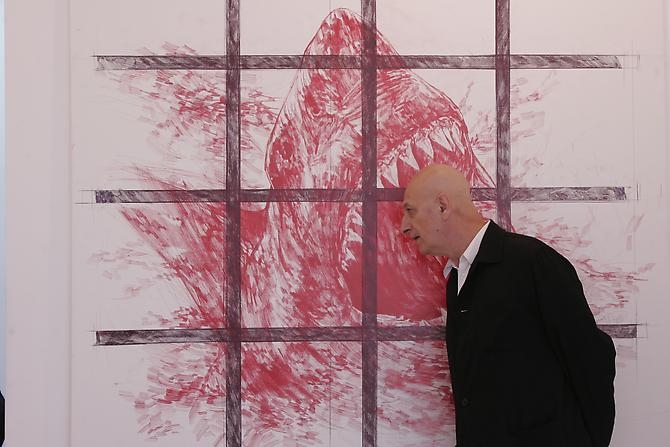
It was during his time as a soldier that Andrei Molodkin began his ballpoint pen drawings, which have a predominantly political focus. In this work – ‘Ceci n’est pas Merkel’ – Molodkin plays with an image of the ‘financial shark’ used by German left-of-centre party SPD for its election poster campaign in spring 2009, with a definite nod to a painting of Belgian surrealist René Magritte.
The exhibition also features vintage photography by Alexander Rodchenko, one of the protagonists of Russian Modernism.
Before Rodchenko adopted the medium of photography in the mid-1920s, he had already made a name for himself in Moscow as a versatile and innovative artist.
Rodchenko’s approach to photography was a radical departure from the art photography that held sway at the turn of the century. The aim was to revolutionise the perspective of photography, offering a “new perspective” that would change society and people – in a time of epoch-making changes in Russia and Europe alike.

QUOTATION
The last series of the ROSTA posters was issued at the time when the Constructivists defied easel painting and committed themselves to production art. Thus the ROSTA collective, with the poet and artist Vladimir Mayakovsky on board, contributed to the new phase of the Russian avant-garde that guarded art from succumbing to the level of mere commodity. Success-fully advanced by the post-war neo-avant-garde artists, this paradigm of socially conscious aesthetics has fallen — under the pressure of today’s narcissistic individualism — into the category of endangered species. Andrei Molodkin’s ballpoint drawings that pulsate with the muscle power of “the artist as producer,” resuscitate the productivist model of art making; this time he renders a dichotomous image of a bloody shark reminding us that this mode of production is simultaneously powerful and vulnerable.
Dr. Margarita Tupitsyn

QUOTATION
Our fascination with Steven Spielberg’s film Jaws (1975) hints at the possibility that at the time of the ongoing financial crisis the global economy has misrecognized itself for a shark or used this image as a cover up for its crypted identity – “Vagina Dentata.” If “animals are sick of surplus value,” men must be sick of castration anxiety.
The notion that a shark is an exceptional swimmer is self-explanatory because it lives in water. A similar argument applies to Andrei Molodkin’s swimming in negativity. For as long as he stays there, his competence is hardly in question. Negativity mon amour is the slogan of today, for it prompts the artist to settle scores with what none of us should accept or tolerate.

Professor Dr. Victor Tupitsyn

ANDREI MOLODKIN

Andrei Molodkin
ANDREI MOLODKIN

April 18th – June 24th, 2009

| DE

Galerie Priska Pasquer is proud to host the first ever individual exhibition in Germany to be dedicated to Russian artist Andrei Molodkin. It will also be presenting his work at Art Cologne at the same time.
Born in 1966, Andrei Molodkin attained international recognition in recent years owing to his politically motivated crude oil sculptures and large-scale ballpoint pen drawings and is to represent Russia this year at the 53rd Venice Biennale.
Andrei Molodkin’s sculptures consist of transparent Plexiglas structures that are hollowed out inside in the form of a phrase or sculpture. Using connected pipes, the artist then fills this matrix with crude oil from Chechnya, Iraq or Iran.
In his sculptures, Molodkin uses words and shapes that play a central role in political, economic or religious issues. He sees phrases or slogans such as ‘Hope’, ‘Democracy’, ‘Das Kapital’ or ‘Yes we can’ as empty vessels that can be filled in very different ways depending on the context.
Into these moulds, Molodkin injects crude oil – one of the world’s oldest raw materials yet the lifeblood of today’s economic system.
In this way, Molodkin initiates a political and cultural discourse in which the terms used – and, in turn, man’s cultural heritage – are replaced by ‘black gold’ as the central commodity.
Words such as ‘hope’ are – and always have been – used and abused by political and religious leaders and their agents. By filling these with crude oil, the artist highlights the radical extent to which economics has penetrated and dominated culture and politics.
In a time in which words are used as vessels into which equally empty ideologies and discourses can be poured, Andrei Molodkin sees not only his works of art but also culture as a whole as being filled with “an emptiness that we have to fill and affirm with economics”.
By making crude oil a key part of his art, Andrei Molodkin transforms this essential industrial raw material into an aesthetic form. Besides the aspect of increasing the (mercantile) value of a material that is rarely used in art, Molodkin sees the fuel – which, after all, is derived from long-dead organisms – as symbolising the cycle of life and death, a theme that is also addressed in his drawings.
Molodkin’s relationship with crude oil began back in his army days, when he was given the task of accompanying gigantic oil cisterns that were being transported to Siberia by rail, using residue from the containers as a means of keeping warm. Later on, when working on a photography project in Northern Russia, he came into contact with the giant crude oil cisterns which he found to look like cathedrals on the inside. This reminded the artist of reports in the Russian media describing crude oil as the “flesh and blood of the nation” and inextricably linking national resources with the national identity.
It was during his time as a soldier that Andrei Molodkin began his ballpoint pen drawings. These large-scale drawings frequently feature a death’s head as a motif. As well as using the iconography of death, the time-consuming process involved in producing these works also brings together life and death: on the one hand birth in the creation of the picture, the entire evolution of which can be traced through ballpoint pen strokes, and, on the other, death symbolised by the completion of the work.
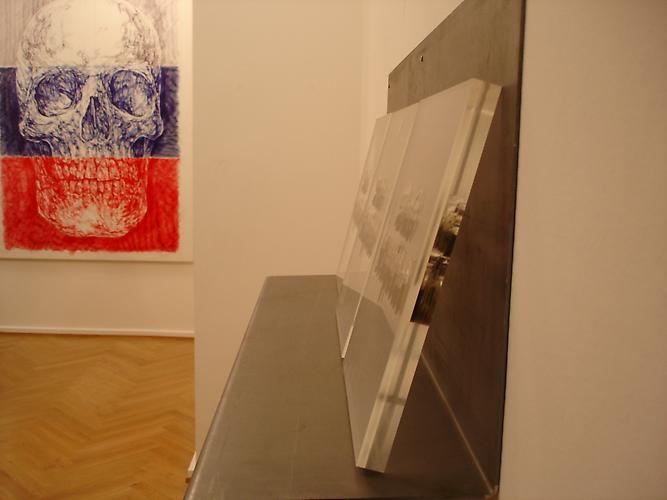
In the drawing exhibited at Galerie Priska Pasquer, Molodkin introduces a political component to this approach by adding the colours of the Russian flag to the death’s head. As well as the death’s head motif, Molodkin creates ballpoint pen drawings with specific political or economic references – a prime example of this is ‘Gazprom’, which depicts the headquarters of Russian energy group Gazprom.
At the time of writing, Andrei Molodkin’s latest project is generating extensive media coverage, with newspapers such as the Independent, Artinfo, the Evening Standard and The Times reporting on Molodkin’s intention of continuing to use the notion of crude oil to symbolise the cycle of life and death. The artist has developed a technique for converting human bodies into crude oil that can then be used for sculptures.
Brief biography:
Born in Boiu, Russia, in 1966; currently living in Paris and Moscow. Attended the Special School of Arts-Plastiques, Boui (1976-1980), the College of Arts, Krasnoe-on-Volga (1985-1987), and the Faculty of Interior Architecture of the Stroganov Art Academy, Moscow. Military service (1987-1992).
The artist has had his works featured in many individual and group exhibitions in Western and Eastern Europe and in the USA. Furthermore, his works have been covered in publications such as Art Forum, Art Press, Third Text, Kh/Zh, the New York Times, the Village Voice and the Independent.

| EN

Galerie Priska Pasquer is proud to host the first ever individual exhibition in Germany to be dedicated to Russian artist Andrei Molodkin. It will also be presenting his work at Art Cologne at the same time.
Born in 1966, Andrei Molodkin attained international recognition in recent years owing to his politically motivated crude oil sculptures and large-scale ballpoint pen drawings and is to represent Russia this year at the 53rd Venice Biennale.
Andrei Molodkin’s sculptures consist of transparent Plexiglas structures that are hollowed out inside in the form of a phrase or sculpture. Using connected pipes, the artist then fills this matrix with crude oil from Chechnya, Iraq or Iran.
In his sculptures, Molodkin uses words and shapes that play a central role in political, economic or religious issues. He sees phrases or slogans such as ‘Hope’, ‘Democracy’, ‘Das Kapital’ or ‘Yes we can’ as empty vessels that can be filled in very different ways depending on the context.
Into these moulds, Molodkin injects crude oil – one of the world’s oldest raw materials yet the lifeblood of today’s economic system.
In this way, Molodkin initiates a political and cultural discourse in which the terms used – and, in turn, man’s cultural heritage – are replaced by ‘black gold’ as the central commodity.
Words such as ‘hope’ are – and always have been – used and abused by political and religious leaders and their agents. By filling these with crude oil, the artist highlights the radical extent to which economics has penetrated and dominated culture and politics.
In a time in which words are used as vessels into which equally empty ideologies and discourses can be poured, Andrei Molodkin sees not only his works of art but also culture as a whole as being filled with “an emptiness that we have to fill and affirm with economics”.
By making crude oil a key part of his art, Andrei Molodkin transforms this essential industrial raw material into an aesthetic form. Besides the aspect of increasing the (mercantile) value of a material that is rarely used in art, Molodkin sees the fuel – which, after all, is derived from long-dead organisms – as symbolising the cycle of life and death, a theme that is also addressed in his drawings.
Molodkin’s relationship with crude oil began back in his army days, when he was given the task of accompanying gigantic oil cisterns that were being transported to Siberia by rail, using residue from the containers as a means of keeping warm. Later on, when working on a photography project in Northern Russia, he came into contact with the giant crude oil cisterns which he found to look like cathedrals on the inside. This reminded the artist of reports in the Russian media describing crude oil as the “flesh and blood of the nation” and inextricably linking national resources with the national identity.
It was during his time as a soldier that Andrei Molodkin began his ballpoint pen drawings. These large-scale drawings frequently feature a death’s head as a motif. As well as using the iconography of death, the time-consuming process involved in producing these works also brings together life and death: on the one hand birth in the creation of the picture, the entire evolution of which can be traced through ballpoint pen strokes, and, on the other, death symbolised by the completion of the work.
In the drawing exhibited at Galerie Priska Pasquer, Molodkin introduces a political component to this approach by adding the colours of the Russian flag to the death’s head. As well as the death’s head motif, Molodkin creates ballpoint pen drawings with specific political or economic references – a prime example of this is ‘Gazprom’, which depicts the headquarters of Russian energy group Gazprom.
At the time of writing, Andrei Molodkin’s latest project is generating extensive media coverage, with newspapers such as the Independent, Artinfo, the Evening Standard and The Times reporting on Molodkin’s intention of continuing to use the notion of crude oil to symbolise the cycle of life and death. The artist has developed a technique for converting human bodies into crude oil that can then be used for sculptures.
Brief biography:
Born in Boiu, Russia, in 1966; currently living in Paris and Moscow. Attended the Special School of Arts-Plastiques, Boui (1976-1980), the College of Arts, Krasnoe-on-Volga (1985-1987), and the Faculty of Interior Architecture of the Stroganov Art Academy, Moscow. Military service (1987-1992).
The artist has had his works featured in many individual and group exhibitions in Western and Eastern Europe and in the USA. Furthermore, his works have been covered in publications such as Art Forum, Art Press, Third Text, Kh/Zh, the New York Times, the Village Voice and the Independent.